
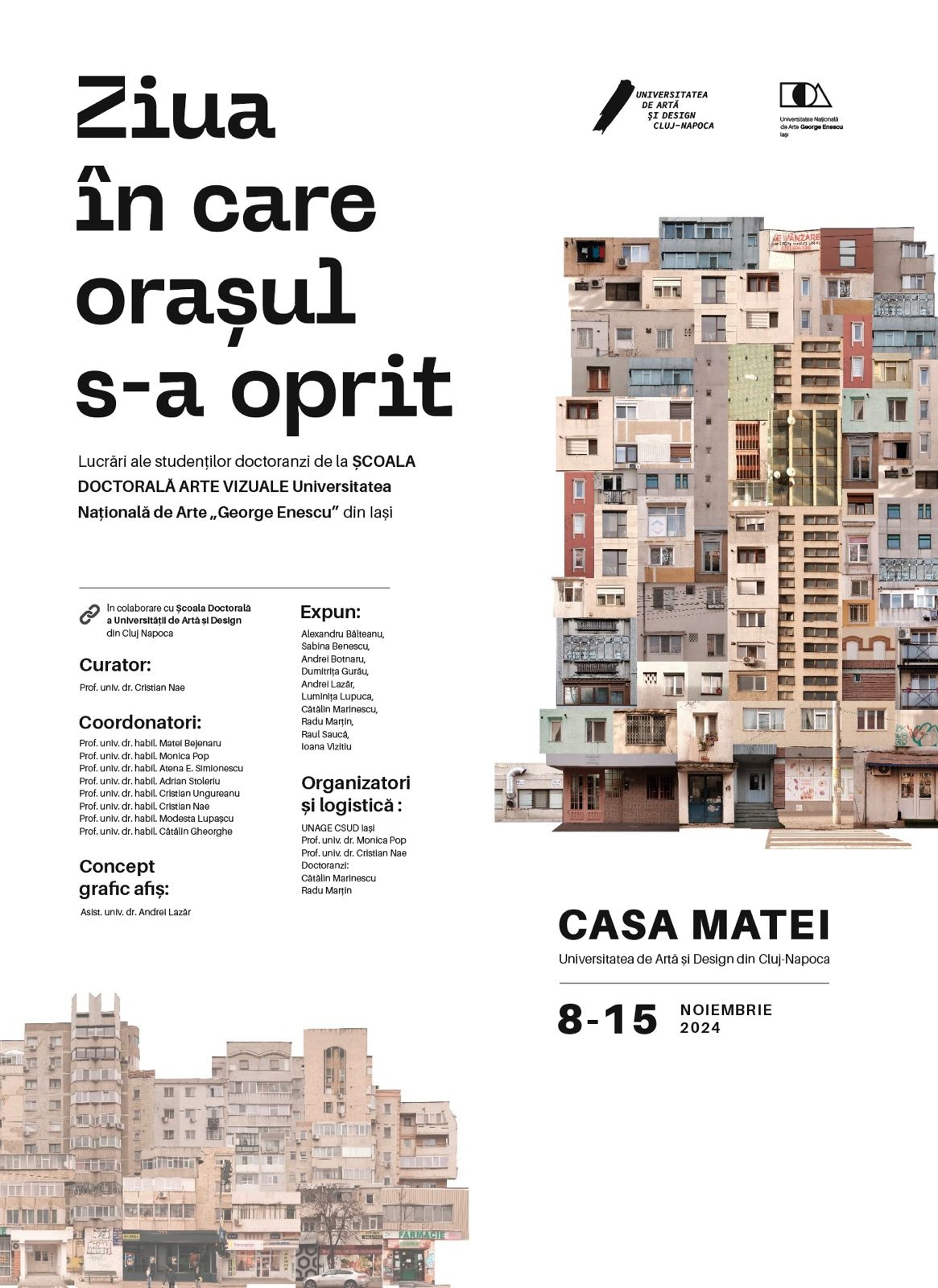
University of Art and Design in Cluj-Napoca, “George Enescu” National University of Arts in Iași, in collaboration with the Doctoral School of the University of Art and Design in Cluj-Napoca
The Day the City Stood Still
Works by PhD candidates of the DOCTORAL SCHOOL OF VISUAL ARTS, “George Enescu” National University of Arts in Iași
CASA MATEI, University of Art and Design in Cluj-Napoca
8–15 November 2024
Curator: Prof. Cristian Nae, PhD
Coordinators:
Prof. Matei Bejenaru, PhD, habil.
Prof. Monica Pop, PhD, habil.
Prof. Atena E. Simionescu, PhD, habil.
Prof. Adrian Stoleriu, PhD, habil.
Prof. Cristian Ungureanu, PhD, habil.
Prof. Cristian Nae, PhD, habil.
Prof. Modesta Lupașcu, PhD, habil.
Prof. Cătălin Gheorghe, PhD, habil.
Poster graphic design:
Assist. Prof. Andrei Lazăr, PhD
Exhibiting artists: Alexandru Bălteanu, Sabina Benescu, Andrei Boraru, Dumitrița Gurău, Andrei Lazăr, Luminița Lupuca, Cătălin Marinescu, Radu Martin, Raul Saucă, Ioana Vizitiu
Organizers and logistics:
UNAGE Doctoral School (Iași)
Prof. Monica Pop, PhD, Prof. Cristian Nae, PhD
PhD candidates: Cătălin Marinescu, Radu Martin
Under the title The Day the City Stood Still, the curatorial concept of the exhibition selects works that explore the experience of moving through urban space and of inhabiting the city under conditions of chaotic transformation and increasing urban density in Romania, as well as the intensification of touristic urban experiences on a global scale. The epidermic, superficial, high-speed experience of the city turns it into an image — an environment saturated with aesthetic stimuli — advertisements, fonts, sounds, smells, illuminated streets, hidden corners — intended for hedonistic consumption, and into a space of transit rather than one of sustainable dwelling and long-term community building.
The sometimes nostalgic memory of the recent past in cities such as Iași, which experienced capitalist transformations with a certain delay, is combined in this exhibition with experiences of alternative futures — expressed through futuristic industrial models in a feminist critical key or through post-industrial cyberpunk graphic narratives — in order to reconstruct the city of Iași from multiple subjective perspectives. These perspectives intersect at the boundary between utopia, dystopia, and retro-futurism, offering the experience of a non-place, a predominantly interstitial space. (Prof. Cristian Nae, PhD)